Showing posts with label Peter Rabe. Show all posts

Saturday, March 28, 2015

Forgive Me Killer – Harry Whittington


Harry Whittington’s reputation reigns as one of the proprietors of the paperback originals. As my education continues on vintage crime novels, I can begin to distinguish the shift from the pulps to the affordable paperback novels that exploded in the latter half of the 20th century. Paperback first edition novels stemmed from publishers such as Fawcett GoldMedal, Signet, Bantam Books, Avon, and Ace. Authors such as John D. McDonald, David Rabe, and most importantly, Harry Whittington carved out a new avenue for the mystery crime genre, not to forget the western, science fiction, romance, or horror genres, to excel. By Whittington’s own account, his prolific output was out of necessity and eventually he was discouraged and quite writing for several years to work for the government, which paid regularly. His output is over 200 novels in various genres including the western. His pseudonyms include Robert Hart-Davis, Harry White, and Hallam Whitney to name a few.

Published in 1956, Forgive Me Killer follows corrupt police officer, Mike Ballard, called to prison to help clear a convicted and sentenced Earl Walker. In desperation, Walker mistakes Ballard’s indifference to his arraignment as compassion and believes that Ballard is a decent human being. Rejecting the plea for help, Ballard returns to work to find himself hit up for a loan by a fellow officer and under investigation with D.A. for his questionably wealthy lifestyle.

Ballard reports to and takes his cut from the local mob boss and club owner, Luxtro, whose hand is in each of the highest city officials’ pocket. Ballard demands that Luxtro pull his strings and have his investigation called off. Luxtro pays Ballard and additional amount of money and promises to look into the investigation, but warns him to lay low and not make any additional waves in the department. An investigation as serious as the one he’s facing is almost impossible to influence.

Meanwhile, convict Earl Walker’s wife, Peggy, pays Ballard a visit in attempt to convince him to clear her husband’s name. Frustrated with his girlfriend, Ballard’s selfish lust for Peggy prompts his agreement to help her imprisoned husband. Knowing that seducing Peggy won’t make a difference if her husband remains in prison, Ballard wants to win Peggy’s trust before he takes her to bed. Unfortunately, the more Ballard looks into Walker’s case the heavier the D.A.’s investigation comes down on him. Despite the hole that Ballard continues to dig, his lust drives him to discover the truth about Earl Walker’s conviction.


Forgive Me Killer’s brevity astonishes me due to the jam-packed story line that the novel tells efficiently. The characters are rich. Despite Ballard’s immoral lifestyle, he is a likeable protagonist that is capable of pulling the narrative through its story arc. Interestingly enough, here is a story that is quite familiar in this day and age of constant Law and Order and C.S.I. spin offs. This novel is still refreshing and tells a good crime story. That’s what’s important to me. My version is a reprint from 1984 published by Black Lizard.

Thursday, January 29, 2015

Top of the Heap by Erle Stanley Gardner writing as A.A. Fair


There is a saying in my head that states, “You read one HardCase Crime; you have to read another!” So, shortly after finishing Peter Rabe’s Stop This Man! from the Hard Case Crime imprint, I immediately went to my shelves and discovered I had another Erle Stanley Gardner book that I had shamefully neglected. Top of the Heap (1952) published under the pen name of A.A. Fair; features the private eye team of Cool and Lam, and like the Perry Mason books, is a long series spanning over 40 years. This work was number thirteen!

Normally, I do make an effort to read an author’s work in order of the series, but I was so compelled to read this book after the first paragraph that I couldn’t stop reading it. The novel begins with a tall, burly character pausing at the door of our duo detectives’ agency and simply asks, “B. Cool?” That line makes me chuckle. Perhaps it’s the modern connotation of the word cool, but I found that a part of a great opening scene.

Not knowing the series past events I was worried that I would be lost, but I didn’t feel that way at all. The story picks up right away. Bertha Cool is the senior, controlling partner at the agency and Lam is the chief operative that does most of the groundwork. The agency is hired to find a couple of ladies that seemed to have abandoned our burly gentleman from the opening, but after Lam figures that the job was a set-up for a quick alibi; he begins to dig a little deeper into this affair at the cost of the agency’s, and his own, good name. The story entangles when trying to unravel the shady business inside a nightclub named the Green Door that has tangled into a mobster’s affairs. While the owner of several mining companies, one coincidentally named the Green Door, goes missing, all evidence leads to Lam’s client committing murder and disposing of the body.

What really strikes me about Gardner’s work is the consistency and detail in his structure, and this is only the second novel I’ve read by Gardner. I could feel the elements of the mystery stacking up and playing out in much the same way as The Case of the Velvet Claws. 


For example, in the Velvet Claws, Perry Mason is accused of murder and wanted by the police; but, refuses to stop defending his client until his accuser is proven wrong despite the fact that the accuser and the client is the same person. Likewise, Lam, accused of blackmail after exposing the phony alibi angle refuses to stop working for his client despite the pursuit of the law and the mob. In fact, the client hires Lam to establish a phony alibi creates a good deal of suspicion from the start. There’s definitely a pattern here and one that I hope to explore further with my future reading of Gardner’s work. I really felt comfortable in Gardner’s hands, if you could describe reading a novel that way.


However, and most importantly, it is quite entertaining.

Saturday, January 24, 2015

Stop This Man! by Peter Rabe


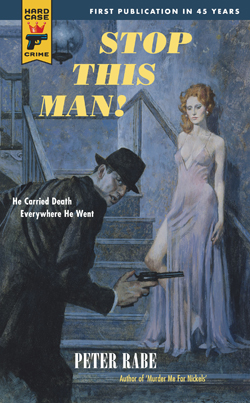
Peter Rabe's body of work is a relatively new discovery for me with the bulk of his work produced in the fifties and sixties. His original Gold Medal paperbacks aren't easy to find, at least in my general area. However, I did pick up the very collectible Hard CaseCrime reprint of his 1955 novel Stop This Man! I'm a big fan of the Hard Case Crime imprint. Not only has the series introduced me to a great number of authors; they have also upheld the classic tradition of pulp artwork as evidenced by the cover of this book. That artwork alone makes me want to read it without even skimming the synopsis on the back.

I must say that the tone of this novel is very bleak and straight forward with a no-nonsense style prose. I have read that Donald Westlake was influenced by Rabe's writing style and I can definitely recognize that in Westlake's pseudonym Richard Stark novels. There's just enough character development to get the story moving and as the events unfold; there are just enough tidbits of background to become completely absorbed in the action.

Much like a film or a screenplay, the narrative alternates between characters. At first, it appears to be an FBI procedural/ chase novel, but it twists again becomes a heist novel. Then it twists back again into a chase. In retrospect, I find that this is what I enjoyed most; that is, the inability to pigeonhole the type of crime story that it tells. In fact, it contains FBI, Mobsters, ex-cons, dames, botched heists, gold, and nuclear radiation! (On a side note, the film version of Mickey Spillane's Kiss Me Deadly, also produced in 1955, deals with a mysterious stolen package that contains a valuable substance that turns out to be contaminated. The two stories would make a very interesting academic comparison in a much larger work for another day.)

At first, I actually thought this novel was going to be a disappointment; yet, Rabe is able to contain these elements into a story frame without running off course in any direction. The plot begins with an ex-con's supposed final heist. It goes wrong when he manages to steal contaminated gold ore. The ex-con, Catell, is determined to avoid another prison sentence, and in his efforts to off-load his contaminated score and avoid the authorities; he manages to sicken, not only himself, but also everyone around him. Which makes tracking his where a bouts that much easier for the FBI.
Catell's character has a very existentialist vibe to him and reminds me of the films of Jean-Pierre Melville, such as Le Samouri. Without guessing the ending, you already feel that this character is doomed from the start.

Overall, I would recommend Rabe’s Stop This Man!