Tuesday, March 31, 2015

A Taste for Violence – Brett Halliday


Brett Halliday’s Mike Shayne detective series spans across 4 decades. Author Davis Dresser used the Halliday pseudonym until the early fifties eventually handing the reins over to other authors to carry on the character. I’ve been curious about these novels for quite sometime, but I’ve always tried to find the earliest novel before delving straight into the series. Taste for Violence (1949) was the earliest Halliday novel in my collection. Therefore, I finally decided to start there and I’m not convinced it was the best novel to introduce the Shayne character.

Charles Roach, heir to a mining dynasty in Centerville, KY, writes to Miami Detective Michael Shayne requesting his services. On the eve of negotiating a truce with striking miners, Roach feels that his life is in jeopardy and generously writes a $5000 retainer check and mails it. Shayne cashes the check and with his secretary travels to Kentucky only to find Roach already murdered. Obligated to accept the job, Shayne uncovers more than just murder and small town corruption.


For a novel titled Taste for Violence, the action plays out in the distance or off-screen. Shayne and his secretary witness the mine’s private police force brutality attack a motorist from their car. A key character commits murder just outside his office door. Suspects escorted through the police station already have a confession beaten out of them.

Mike Shayne seems to soak all this small town corruption up before taking action. To be honest, I was hoping for more wise cracks. Not being familiar with the earlier novels, I’m uncertain that this is the normal Shayne mystery or an off the beaten path story. I do like the rural Kentucky setting and the set-up motives and suspects develop quite nicely, but as I mentioned above, with the action happening off screen, the novel becomes almost bland. However, when Shayne does finally take action the story kicks into high gear and delivers the goods. It’s particularly good, when Shayne pretends inebriation so that his arrest will allow his interrogation of an incarcerated suspect in Roach’s murder. In addition, Shayne eventually works his magic to become an Interim Sherriff to clean up the town.


Overall, I was hoping a better Shayne mystery to launch my education on Brett Halliday’s work. Halliday died in the late 1970’s. I still have plenty to read by Halliday and apparently, there are many Shayne stories that were ghost written by esteemed crime authors such as Bill Pronzini. I will continue to pick up any copies of his work that I might find. Finally because I couldn’t resist the terrible puns: A Taste of Violence just didn’t satisfy my appetite, but it was a good appetizer.


Saturday, March 28, 2015

Forgive Me Killer – Harry Whittington


Harry Whittington’s reputation reigns as one of the proprietors of the paperback originals. As my education continues on vintage crime novels, I can begin to distinguish the shift from the pulps to the affordable paperback novels that exploded in the latter half of the 20th century. Paperback first edition novels stemmed from publishers such as Fawcett GoldMedal, Signet, Bantam Books, Avon, and Ace. Authors such as John D. McDonald, David Rabe, and most importantly, Harry Whittington carved out a new avenue for the mystery crime genre, not to forget the western, science fiction, romance, or horror genres, to excel. By Whittington’s own account, his prolific output was out of necessity and eventually he was discouraged and quite writing for several years to work for the government, which paid regularly. His output is over 200 novels in various genres including the western. His pseudonyms include Robert Hart-Davis, Harry White, and Hallam Whitney to name a few.

Published in 1956, Forgive Me Killer follows corrupt police officer, Mike Ballard, called to prison to help clear a convicted and sentenced Earl Walker. In desperation, Walker mistakes Ballard’s indifference to his arraignment as compassion and believes that Ballard is a decent human being. Rejecting the plea for help, Ballard returns to work to find himself hit up for a loan by a fellow officer and under investigation with D.A. for his questionably wealthy lifestyle.

Ballard reports to and takes his cut from the local mob boss and club owner, Luxtro, whose hand is in each of the highest city officials’ pocket. Ballard demands that Luxtro pull his strings and have his investigation called off. Luxtro pays Ballard and additional amount of money and promises to look into the investigation, but warns him to lay low and not make any additional waves in the department. An investigation as serious as the one he’s facing is almost impossible to influence.

Meanwhile, convict Earl Walker’s wife, Peggy, pays Ballard a visit in attempt to convince him to clear her husband’s name. Frustrated with his girlfriend, Ballard’s selfish lust for Peggy prompts his agreement to help her imprisoned husband. Knowing that seducing Peggy won’t make a difference if her husband remains in prison, Ballard wants to win Peggy’s trust before he takes her to bed. Unfortunately, the more Ballard looks into Walker’s case the heavier the D.A.’s investigation comes down on him. Despite the hole that Ballard continues to dig, his lust drives him to discover the truth about Earl Walker’s conviction.


Forgive Me Killer’s brevity astonishes me due to the jam-packed story line that the novel tells efficiently. The characters are rich. Despite Ballard’s immoral lifestyle, he is a likeable protagonist that is capable of pulling the narrative through its story arc. Interestingly enough, here is a story that is quite familiar in this day and age of constant Law and Order and C.S.I. spin offs. This novel is still refreshing and tells a good crime story. That’s what’s important to me. My version is a reprint from 1984 published by Black Lizard.

Monday, March 23, 2015

Halo in Brass – Howard Browne


Halo in Brass is the third Paul Pine detective novel from Howard Browne published in 1949. Browne made his living editing pulp magazines before making the pilgrimage to Hollywood. I discovered Browne after reading about him in reference to the work of Raymond Chandler. Browne’s ambition was to create a mystery novel where the killer was the least likely suspect. Naturally, I found this quite intriguing. As I’ve mentioned before in a previous post, the giallo film is what led me by the hand to the crime novel. Gialli, at times, thrive on convoluted twisty turns and sudden “gotcha” out of no-where killer revelations that can be both surprising and disappointingly illogical. Once I discovered that Browne worked to construct his novel in a way that guessing the killer was to be the challenge, I had to see for myself how it compared.

In short, Halo in Brass delivers the goods. Hometown Nebraska girl Laura Freemont has been missing for eight months in the Windy City. Her parents hire detective Paul Pine to track her down. Pine has a penchant for wise cracks and humorous observations while he investigates Laura Freemont’s known associates. Oddly enough, as his investigation unwinds Laura’s contacts start turning up dead and it’s not long before Pine is a suspect.

Browne acknowledges in his introduction to the McMillan Press reprint that his book negatively centers on lesbian themes. He also considers his own beliefs were negative, but changed since the timeframe of the original writing. The novel includes salacious subject matter considering the book came out in the late forties. Comparatively, the novel seems tasteful when stacked up to contemporary films such as Basic Instinct or Jade. However, placing a work in the context of its era adds a specific layer of social observation that’s pertinent at the time written. I think it’s important to know how those themes resonated in the time-period and how they play into the construction of the narrative and the audience’s perceptions.

Most importantly, the novel is good hard-boiled fun. It doesn’t beat around the bush and the plot works in a logical fashion. The one aspect of the story that really pays off is the revelation of the killer. I won’t spoil it, but it does work even despite countless movies and books that I’ve been exposed to using a similar plot mechanism. Browne even uses a Mark Twain reference that helps solve the mystery! I am currently tracking down Browne’s other novels including the other Paul Pine mysteries. Several titles were originally published under the pen name of John Evans. Browne died in 1999.


Thursday, March 5, 2015

One Monday We Killed Them All – John D. MacDonald


John MacDonald fits into a select group of crime authors with a long spiraling list of accomplishments. Attempting to digest each of the author’s books is an intimidating task, but promises to be a rewarding one. MacDonald’s best known for his Travis McGee series, which contains over 20 books, and the original novel that the movie Cape Fear was based upon called The Executioners. While I haven’t vowed to read all the Travis McGee series (I’ve only read The Deep Blue Goodbye and I did enjoy it), I’ve been steadily collecting his works as I find them. In the meantime, I’ve enjoyed a handful of MacDonald’s stand-alone crime novels.

One Monday We Killed Them All published in 1961 by GoldMedal starts reminiscently of The Executioners as the release of Dwight McAran from prison. His manslaughter prison sentence has ended after the death of his former girlfriend who has died from injuries sustained from his abuse. Unfortunately, for Lieutenant Fenn Hillyer, Dwight McAran is his brother-in-law who needs a place to stay after his prison term. Convinced to give McAran a place to get back on his feet by his wife, Meg, Hillyer must walk a fine line between duty and devotion, while his house quickly becomes the new roadside attraction for the town.

Meg seems to be the only individual on the face of the planet that believes her brother has had a bum rap. Meg is downright sure that he is capable of turning his life around. She criticizes her husband for being distrustful of McAran, even after he discovers that McAran has assaulted her in front of their child. Meanwhile, Hillyer’s police chief gives orders not to coerce McAran into any actions that would lead to his arrest; after all, McAran has served his time in full. However, Hillyer’s unofficial surveillance on his brother-in-law reveals that McAran is waiting for someone or something that will trigger his long gestating revenge on everyone. Eventually, McAran’s only known associates have incited a riot and escaped from prison.


The writing is tight, precise, and economical. Immediately, MacDonald sets up a multilayered source of conflict and tension that builds throughout the novel. Hillyer is not afraid of McAran, but he is afraid for his family. Likewise, McAran waits patiently and fearlessly for his opportunity to commit revenge. Enraptured by the course of events unfolding throughout the novel, I felt that the characters interacted logically. McDonald is able to paint his scenes with just the right amount of anxiety that when key scenes happen, the reader responds accordingly with the intended emotions. An early scene in the novel with the Hillyer’s family pet and McAran, illustrates this perfectly. Overall, I highly recommend this work as an outstanding example of pacing and suspense. The ending also delivers that high emotional impact that punches you in the gut. I do promise to read more MacDonald this year.

Thursday, February 26, 2015

Devil on Two Sticks by Wade Miller


Wade Miller is the pseudonym for co-authors Bob Wade and Bill Miller. The pair first came to my attention by another pen name they used of Whit Masterson. Badge of Evil (1954) by Masterson is the novel that Orson Welles’s film Touch of Evil is based upon. While searching for that novel, I stumbled across the Wade Miller name. Devil on Two Sticks published in 1949 and reprinted in 1950 under the title of Killer’s Choice. The 2008 version I obtained was from Stark House and contained an extra novel by the duo called The Killer (1951).


Beck is a snappy dresser complete with pastel sweaters, tweed suits, and a perfectly tied bow tie. He drives an expensive coupe and parks the car where he can always see it. He moves in an almost mechanical precision for his crime syndicate boss named Pat Garland. On his off time, Beck’s a lady’s man and has a fling with his boss’s wife. Meanwhile, a young woman, named Marcy Everett, which he met right before a raid one of the syndicate’s gambling houses, distracts Beck.
Released from jail with the aid of the syndicate’s new lawyer J.J. Everett, Garland calls Beck into action to expose a mole for the Attorney General that has breached their inner circle. Exposed details of the syndicate’s criminal operations single-out a select group of individuals. Beck gathers the data and inputs his list of suspects into his memory banks to process. As the suspects are investigated, one syndicate member is found dead and another looks highly suspicious. Beck’s intuition fingers Harvey Isham for the mole and Garland orders his elimination; a mistake that causes the Circle’s inner trust to break.

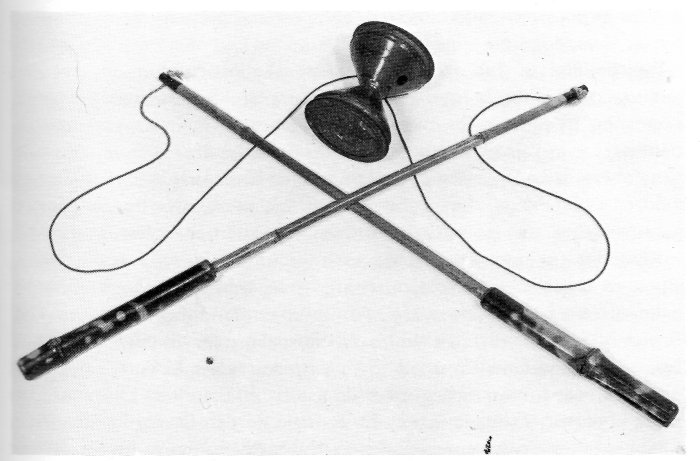
As a lead character, Beck is not exactly amiable. He’s very stiff. He doesn’t quip the wise cracks or flash his gun, in fact, he doesn’t even carry a gun. The majority of his emotions remain internalized and surface only when necessary. Beck is very clean and organized except when something disrupts his everyday patterns. Beck is the Devil on Two Sticks caught between the two sides of his life, which Beck literally demonstrates in the novel at a dinner party with a toy diabolo. However, torn by his professionalism and his emotions for Marcy Everett, Beck soon realizes that either direction will have severe consequences.


Devil on Two Sticks is not action packed, but its not without its share of exciting moments. Particularly, a chase in the dark of a funeral home was well paced and suspenseful. I was expecting a straightforward crime novel, but there’s much more underneath the surface of this existentialist crime novel than I expected. The writing is very mechanical and emotionless. In retrospect, this may have been the author’s intent because the writing style interlocks with Beck’s characteristics too. Everything is logical and precise clockwork, which created a stilted reading experience. In that respect, the ending is unsatisfying but is correct and works for the story. The novel also has a touch of redemption at the end. Beck chooses to walk away without completing his assignment to prove that love can change a person.


Wednesday, February 18, 2015

Perfidia by James Ellroy


James Ellroy’s Perfidia is quite an undertaking, not only for the reader, but also for its shear scope of Los Angeles history. The first of a new quartet of novels that spans the war years of 1941 to 1946 in America leading up to the events in the original L.A. Quartet that consists of TheBlack Dahlia, The Big Nowhere, L.A. Confidential, and White Jazz. The novel also connects with Ellroy’s most recent work, dubbed the Underworld USA Trilogy, consisting of American Tabloid, Blood’s A Rover, and The Cold Six Thousand. Overall his cannon of work unveils a fictitious, dark and hidden history of the Los Angeles police force that works its way into the FBI and finally into the political landscape of the 1960’s and early 70’s.

Admittedly, I was intimidated by tackling such an expansive book coupled with the fact that it’s been many years since I’ve read the original quartet. However, my fears quickly vaporized once I remembered that I was in the hands of a master crime writer. Personally, I think Ellroy is a true successor to Hammett and Chandler in the ways that the authors re-create the hard-boiled criminal underworld with acute vernacular and criminal intent. What is interesting about Ellroy’s style is that it is not merely an imitation of Hammett or Chandler’s work, but an entirely new beast of hard-boiled tough-guy detectives that surpasses Spade, Marlowe, or even the entire Continental Op. This is the next wave of crime writing and it’s exciting because Ellroy is still alive and kicking.


The inciting incident and backdrop of the novel is an investigation into a Japanese family’s ritualistic suicide called seppuku; however, homicide is quickly determined after the investigation reveals key elements that don’t fit in with the ritual. More importantly, this family’s slaying happens on the eve of Pearl Harbor’s bombing which causes resentment, violence, and riots in Los Angeles against Asian minorities. Sadly, the Los Angeles population has trouble distinguishing between the Chinese and Japanese races. Also, in question is whether the murdered family had prior knowledge of Pearl Harbor’s attack due to the presumed suicide note found at the scene of the crime.

Soon after the attack, the L.A.P.D begins to round up questionable Japanese residents into holding cells and work farms. A subplot emerges about farmlands bought for commercial development, but until the war is over, the land becomes Japanese prison camps for monetary gain. A surge of patriotism causes both civilians and the police force to enlist into the armed forces. This action causes a hardship for the Police Department losing many of their best men and potential cadets to the war.
Employed by the L.A.P.D. is police chemist Hideo Ashida, the Department’s sole Japanese employee. Frustrated by being the only Asian minority on the force and hampered by his closet homosexuality, Ashida works hard to keep his position on the force and preventing his family’s detainment in a war camp. Ashida’s commanding officers, Sergeant Dudley Smith and Captain William Parker (Whiskey Bill), quickly recognize his resourcefulness and begin to use him to promote each of their own questionable agendas.

Dudley Smith is both brilliant and sinister. Capable of seducing his prey into unsuspected collaboration and astonishing acts of violence while at the same time manipulating multiple police investigations to his advantage. His acts are incorrigible and, at times, highly intelligent, but motivated by the need for solutions, regardless if they are the correct ones. Before New Year’s Eve, City Hall demands a resolution that the family’s murderer be Japanese, perpetuating a Japanese on Japanese crime that justifies the acts against L.A.’s Japanese population. Therefore, Dudley works to find a Japanese killer. Dudley’s web of deceit is so intricate that the character creates a coded chart in his office so that he can keep track of all his deeds. Meanwhile, Dudley tries to maintain an affair with the one and only Bette Davis.

On the other hand, Whiskey Bill Parker thrives on political career moves that edge him towards the Police Chief’s desk. His hard drinking and public spousal abuse blemish his reputation. Parker entraps a young woman named Kay Lake whose estranged marriage to the department’s Lee Blanchard connects her back with suspected criminal activities within the police force. Her previous testimony has kept Lee Blanchard out of trouble. She and Hideo Ashida also share a mutual affection for a recent police enrollee Bucky Bleichert. Kay willingly partakes in the adventure of a lifetime to oust and infiltrate social-lite communist Claire De Haven’s camp. De Haven, aka The Red Queen and her party are in the process of publishing anti-propaganda tracts against the Los Angeles police department exposing the brutality against the Japanese minorities. Eventually, Parker’s motivation for ousting De Haven becomes confused with his obsession for Kay. Likewise, Dudley’s obsession for Bette Davis causes catastrophic events too.


As different sides of the same coin, Dudley and Parker’s characters clash and complement each other nicely. Similarly, both Kay Lake and Hideo Ashida are pawns in a deadly game where no one is innocent of anything. Every character has something concealed. To whom to swear their allegiance is constantly blurred and continuously shifty. Eventually, every character questions how their role will play out in the bigger picture, which is precisely the point Ellroy makes with Perfidia: don’t sweat the small stuff because in the end it does not matter. When the murder mystery becomes unveiled, the dark manipulations of all the characters and the police force, paired with the declaration of war, manage to place the actual truth on hold. The murderer remains protected by the course of history. To the Mayor’s office and the higher echelons in the department, the true guilty party does not matter as long as the right person burns for the job. History will move on regardless of the outcome. Orchestration of events can happen anyway that you want them to. Which is exactly what Ellroy has done inside his Los Angeles universe mixing true historical characters and events with fictional ones; concocting resolutions that suggest the truths about the Los Angeles police world.

Ellroy’s universe works beautifully. The power of this novel rests in Ellroy’s ability to write economically and efficiently. I don’t want to fool anyone by my meager attempt at summarizing the plot; every cog in this wheel seems meticulously greased. Elloy’s work deserves, or rather demands, consumption.


Thursday, February 12, 2015

Compliments of a Fiend by Fredric Brown


First off, my discovery of Fredric Brown stems from the unauthorized adaptation of his 1949 novel The Screaming Mimi. That film was Italian horror maestro Dario Argento’s The Bird with the Crystal Plumage (1969). It was an international success and a defining example of the Giallo mystery subgenre. 


The giallo-film is a highly stylized type of murder mystery or crime film that usually places a strong emphasis on the violent and sexual aspects of the story. The giallo-film stems from Italian publisher Mondadori’s set of pulp paperbacks with yellow covers hence the name “giallo”. Since the study of the giallo-film leads to the Italian giallo paperbacks, the Italian paperbacks naturally lead to American crime fiction of the early and mid- 20th Century. Translated into Italian, many American crime authors had books published in the giallo paperback series. Therefore, my love for the Italian genre film, called the giallo, has metamorphosed into my love of American crime novels.


Anyway, a long story short, I know, too late; I first tried to track down Fredric Brown’s novel The Screaming Mimi. I quickly found out it is out of print along with the majority of Brown’s work. My first copy of the text was a bootleg. I read it and enjoyed it quite a bit. Furthermore, I’ve always kept an eye out for any of Brown’s novels, and just recently, I stumbled onto a private collection sold to Rhino booksellers. Now, after enjoying The Screaming Mimi, I’m digging into the rest of Brown’s work for the first time and in publication order.

Compliments of a Fiend (1950) was the fourth novel in Brown’s detective series featuring Am and Ed Hunter. As stated above, reading the novels in order I am able to see the progression of a much larger story arc that details the establishment of the Hunter and Hunter Detective Agency. In the first novel, The Fabulous Clipjoint (1947), Ed Hunter stays under Uncle Ambrose’s guidance after his father is murdered. They work together to solve the crime. Ambrose, who has had experience as a detective, works at a Carny and eventually takes Ed, in the subsequent books The Dead Ringer (1948) and The Bloody Moonlight (1949), into the Carny life until they decide to venture out into the world of private cops. Prior to starting their own agency, the Hunters work for the Starlock Dectective Agency and this is where Compliments of a Fiend begins.


Brown’s premise for this novel, inspired by Charles Fort’s work Wild Talents (1932), surmises that after two notable people named Ambrose, Ambrose Bierce and Ambrose Small, disappear under mysterious circumstances that a strange Ambrose Collector must be at work. Strangely enough, Uncle Ambrose doesn’t return home from a job after a man named “Collector” calls and specifically asks for Uncle Am. So begins, Ed’s adventure retracing his Uncle’s steps with the help of their boss, Starlock, and a former carnival burlesque dancer, Estelle. Along the way, we discover a multitude of suspects including a low rent psychic, an amateur photographer, a low life car skip, a crime boss and his menacing henchman. Only Ed is able to tie all the loose ends together to discover what has really happened to his Uncle (and mentor) Am. Only Ed can figure out if a fiend is actually collecting people with the first name of Ambrose.


Brown’s writing is consistently clean and straightforward with a sense of humor. There are a few suggestions of the supernatural to keep things mysterious and light. As I continue to read his work, I am constantly surprised at how well his stories hold up. I also have quite a few of his novels lined up to read this year, so I will continue to log them into my journal entries. McMillian Press published several collections of Brown’s short fiction a few years back, but sadly, those have gone out of print and are collecting enormous sums on the collector’s market (I guess those puns were intending since the book was about collecting). Also available, an omnibus of the first four Ed and Am Hunter novels, published in 2002, by Stewart Masters Publishing that isn’t too hard to find.