Sunday, April 26, 2015

Wild Town – Jim Thompson


Way out west lives an oilman, Mike Hanlon, who manages prolonged success with a thriving hotel despite a debilitating injury that left him in a wheelchair. However, his aged years and wealthy heritage didn’t prevent him from marrying a trophy wife, twenty years his junior, named Joyce. The Hanlon Hotel resides in the jurisdiction of Sherriff Lou Ford, a questionably wealthy officer of the law who by all appearances lives on the grift. Enter the ex-convict drifter, Bugs McKenna, with an uncanny knack for being unable to stay out of trouble, who the Sheriff convinces to apply for the job of the hotel detective, and in turn, convinces Mike Hanlon to hire him. Bugs suspects the crooked Sheriff is up to no good and using an ex-convict as his patsy. Gather these elements together and you will find that the novel is the perfect recipe for criminal mischief.

Bugs McKenna begins his job as the hotel dick at the Hanlon Hotel trying to second-guess the motivations behind his employment. All signs point to Sheriff Ford and Joyce Hanlon working in conjunction to dispose of Mike Hanlon, so Joyce and Sheriff Ford can profit on Joyce’s inheritance and have a fall guy to take the wrap. Despite the obviousness of Ford’s motivations, Mike Hanlon’s motivations seem quite murky. Why does Mike Hanlon decide to trust McKenna? Does his boss realize that a plot is forming around his demise? It isn’t long before other trouble begins to brew at the hotel when $5000 goes missing from the books. The head accountant encourages Bugs to lean on the new accountant in order to save his own job.


Jim Thompson succeeds in taking the conventions of the crime story such as murder, blackmail, grifting, and double crosses and throws each one for a loop. I believe that Thompson’s goal is to keep the reader guessing at every turn and allow enough evidence to sustain a logical assumption of the direction of the story only to deliberately steer it onto a different track. Thompson’s personal sense of humor also matches the streak of black humor that runs throughout the story. For example, my favorite is the death of the hotel accountant, who’s accused in a subplot of stealing $5000, picks a fight with Bugs McKenna and accidentally flies out a window when Bugs dodges his lunge. Our anti-hero Bugs, is the embodiment of Murphy’s Law, if something can go wrong, it goes wrong and in quite a slapstick sort of way.


If it’s discovered that Bugs was in the accountant’s room, his unsavory reputation will jeopardize his safe position at the hotel. This causes him to panic and destroy evidence only later to realize that he couldn’t have been the only other person in the room. Suicide is ruled but quickly changed to murder as evidence of intoxicants in the accountant’s bloodstream turn up in an autopsy. The accountant would have died anyway, despite falling from the window. The Sheriff suspects a female as the culprit, as drugs, according to the Sheriff, are “a female’s weapon of choice.” Even after Bugs establishes his alibi away from the scene of the crime, a blackmailer emerges and puts the heat on him to pay $5000 or risk exposure as a suspect.

The novel takes another turn into quasi-detective fiction. McKenna, who’s hired as the hotel detective despite having no experience as a detective or in law enforcement, must solve the mystery of who is blackmailing him and, in turn, the murderer. The novel could easily fit into an amateur detective sub-genre, but it continues to morph and change styles. I don’t want give away all the twists and turns, but reading it is like listening to a great progressive rock album that shifts sounds and rhythms at will but always manages to impress at the skill of playing.


Wild Town doesn’t sit easily within any confined description of the crime sub-genres. It is all of those things at once and that’s what makes it so damned entertaining. Published in 1957, Wild Town rests comfortably between the more recognized publications of The Killer Inside Me, After Dark,My Sweet, and later publications such as The Getaway and Pop. 1280. I understand that Thompson’s recognition came only after his death, but it makes me question what the public considered great crime fiction at the time. As I’ve read several of his other works, I’m convinced that Thompson was an author that could always invert the crime genre and revitalize it. 

Monday, April 13, 2015

A Stranger in my Grave – Margaret Millar


I felt it was about time to discover some female authors in the crime genre. My pick was none other than Mrs. Ross MacDonald. I’ve read several Ross MacDonald books and I’ve always enjoyed his stories that centered on fractured families and maintaining an air of normalcy within the ideas of socially acceptable society. Drawn to that subject matter and intrigued by the plot synopsis on the back of the book, I decided Millar’s A Stranger in my Grave would be the perfect introduction to the feminine side of the crime genre.

Originally published in 1960, Stranger in my Grave revolves around housewife Daisy Harker’s vivid dream of visiting her own grave at a quaint seaside cemetery marked with her death dated four years ago. What’s troubling about the dream is that Daisy can’t quite place the significance of the grave or the date. Daisy’s family matters seem to play a crucial role in her lack of happiness and unease. Distanced from her well to do husband, Jim, after the discovery of her inability to bear children and irritated by her meddlesome live-in mother who claims that her dreams are unsubstantiated, Daisy also copes with a mostly absent alcoholic father whose hand perpetually extends for handouts and who literally disappears and reappears as any situation dictates.

After a bail bondsman/private detective, Pinata, contacts Daisy to bail her father out of jail, Daisy hires him to piece together the date from her dream that’s etched onto her tombstone. Together they begin an investigation of Daisy’s past with literally no bank accounts, records, or firm memories of where to start. Is Daisy having a memory? Is Daisy having a premonition or a ghostly flashback? Eventually, the seaside cemetery from the dream offers the pair the first clue to the mystery when they find Daisy’s tombstone marked with the name Carlos Camilla. An elderly man that police records indicate committed suicide on that date. As the story unfolds, Daisy discovers a payoff that her husband has obscured for four years and her father has a connection to a Hispanic woman that Daisy once helped at the clinic where she worked precisely four years ago.


Slowly the story’s plot mechanisms begin to turn and build into a grand crescendo that mixes the fractured family histories into an intriguing crime story. Margaret Millar’s story telling is superb. I felt like the author was using the tropes of the Sentimental novel as a springboard cranking it sideways and stuffing it into a mystery novel. It works very well at a slow burn pace. I will say that the twist ending wraps up all the story threads very nicely. Millar, and her husband, MacDonald, excel at these family stories that feature families that use a façade of happiness or normalcy to mask their misfortunes to society. The crucial piece to understand is that all families have something swept under the carpet or hidden in the closets somewhere.

Monday, April 6, 2015

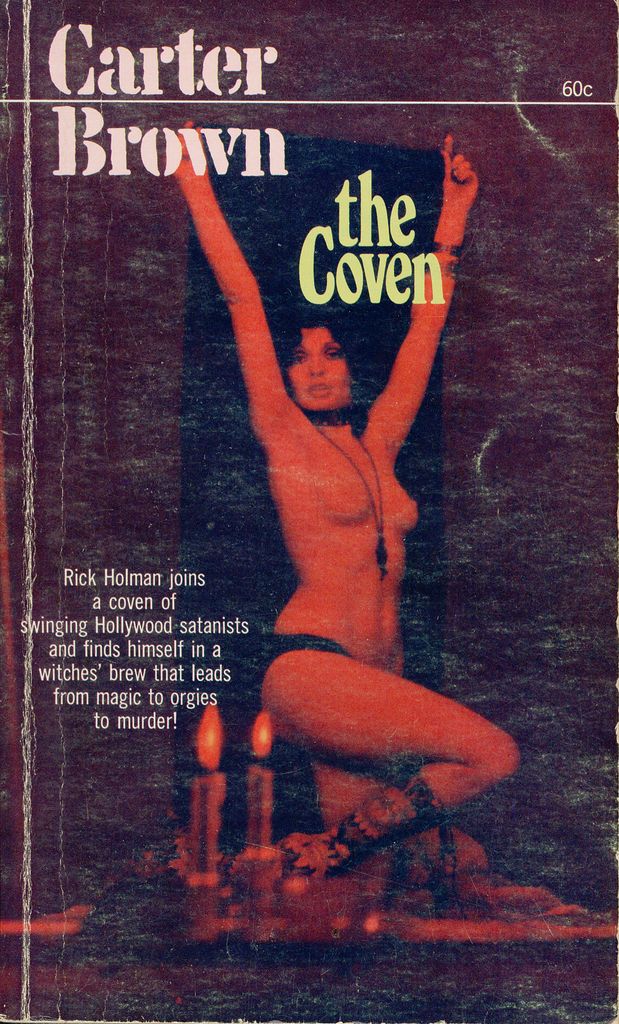
The Coven – Carter Brown


Here is a book that I picked up for the cover alone. Carter Brown’s The Coven is a tantalizing tale of Los Angeles witchcraft loosely inspired by the Manson murders. Published in America in 1971, The Coven is part of the Rick Holman detective series written by the British author Geoffrey Alan Yates using the pen name Carter Brown. Books under the name of Brown were successful enough to feature a stamp proclaiming over 25 million in print. It’s got to be good, right?

The story has an aging Sean Connery type actor named Hector Melvane that is about to be awarded a Knighthood by the Queen. The trouble is that his two children are quite the troublemakers. Pictures of his naked daughter, Amanda, holding a knife over another naked woman indicate that she’s involved in some type of ritualistic games. Her brother, Kirk, known for his violent temper and public outbursts, is also connected, but Hector wants this outlandish behavior squashed before it can ruin his image and his Knighthood. Coincidentally, Kirk and Amanda used to run with their father’s current trophy wife, Brenda, who split with Kirk after he carved his initial between her breasts with a knife.
So, enters Rick Holman, private eye. Hired by Melvane, Holman must find his elusive children and get to the bottom of the scandalous photos. A murder is uncovered and the suspects belong to Amanda and Kirk’s seemingly harmless coven. A group of tight knit friends having a good time acting out rituals involving virginal sacrifices, animal heads, and painting the body with blood. The novel reads like a 1970’s American International Pictures film complete with ample nudity and violence. A book that actually sounds much more exciting than it actually is and comparing this book to AIP is not an insult, I love AIP films!


This book is fun because its exploitative qualities and its politically incorrect nature run rampant. For example, all three of the female leads throw themselves at Rick Holman by exposing and cupping their breasts to tantalize him. Holman manages to bed two of the three with the third one not quite busty enough for his tastes. The mystery isn’t enticing enough to sustain throughout the novel and the witchcraft element seems hokey even by 1970’s standards. 

I was hoping for a more salacious mix of the supernatural and the detective genres, but aside from the sexual aspects, the book is a routine. Although, I was disappointed with the overall product, I would read another Carter Brown. Now that I know what to expect I can look forward to an entertaining quick read that celebrates its own pulpiness. Carter Brown died in the mid Nineteen Eighties with an output of over 300 novels.


Tuesday, March 31, 2015

A Taste for Violence – Brett Halliday


Brett Halliday’s Mike Shayne detective series spans across 4 decades. Author Davis Dresser used the Halliday pseudonym until the early fifties eventually handing the reins over to other authors to carry on the character. I’ve been curious about these novels for quite sometime, but I’ve always tried to find the earliest novel before delving straight into the series. Taste for Violence (1949) was the earliest Halliday novel in my collection. Therefore, I finally decided to start there and I’m not convinced it was the best novel to introduce the Shayne character.

Charles Roach, heir to a mining dynasty in Centerville, KY, writes to Miami Detective Michael Shayne requesting his services. On the eve of negotiating a truce with striking miners, Roach feels that his life is in jeopardy and generously writes a $5000 retainer check and mails it. Shayne cashes the check and with his secretary travels to Kentucky only to find Roach already murdered. Obligated to accept the job, Shayne uncovers more than just murder and small town corruption.


For a novel titled Taste for Violence, the action plays out in the distance or off-screen. Shayne and his secretary witness the mine’s private police force brutality attack a motorist from their car. A key character commits murder just outside his office door. Suspects escorted through the police station already have a confession beaten out of them.

Mike Shayne seems to soak all this small town corruption up before taking action. To be honest, I was hoping for more wise cracks. Not being familiar with the earlier novels, I’m uncertain that this is the normal Shayne mystery or an off the beaten path story. I do like the rural Kentucky setting and the set-up motives and suspects develop quite nicely, but as I mentioned above, with the action happening off screen, the novel becomes almost bland. However, when Shayne does finally take action the story kicks into high gear and delivers the goods. It’s particularly good, when Shayne pretends inebriation so that his arrest will allow his interrogation of an incarcerated suspect in Roach’s murder. In addition, Shayne eventually works his magic to become an Interim Sherriff to clean up the town.


Overall, I was hoping a better Shayne mystery to launch my education on Brett Halliday’s work. Halliday died in the late 1970’s. I still have plenty to read by Halliday and apparently, there are many Shayne stories that were ghost written by esteemed crime authors such as Bill Pronzini. I will continue to pick up any copies of his work that I might find. Finally because I couldn’t resist the terrible puns: A Taste of Violence just didn’t satisfy my appetite, but it was a good appetizer.


Saturday, March 28, 2015

Forgive Me Killer – Harry Whittington


Harry Whittington’s reputation reigns as one of the proprietors of the paperback originals. As my education continues on vintage crime novels, I can begin to distinguish the shift from the pulps to the affordable paperback novels that exploded in the latter half of the 20th century. Paperback first edition novels stemmed from publishers such as Fawcett GoldMedal, Signet, Bantam Books, Avon, and Ace. Authors such as John D. McDonald, David Rabe, and most importantly, Harry Whittington carved out a new avenue for the mystery crime genre, not to forget the western, science fiction, romance, or horror genres, to excel. By Whittington’s own account, his prolific output was out of necessity and eventually he was discouraged and quite writing for several years to work for the government, which paid regularly. His output is over 200 novels in various genres including the western. His pseudonyms include Robert Hart-Davis, Harry White, and Hallam Whitney to name a few.

Published in 1956, Forgive Me Killer follows corrupt police officer, Mike Ballard, called to prison to help clear a convicted and sentenced Earl Walker. In desperation, Walker mistakes Ballard’s indifference to his arraignment as compassion and believes that Ballard is a decent human being. Rejecting the plea for help, Ballard returns to work to find himself hit up for a loan by a fellow officer and under investigation with D.A. for his questionably wealthy lifestyle.

Ballard reports to and takes his cut from the local mob boss and club owner, Luxtro, whose hand is in each of the highest city officials’ pocket. Ballard demands that Luxtro pull his strings and have his investigation called off. Luxtro pays Ballard and additional amount of money and promises to look into the investigation, but warns him to lay low and not make any additional waves in the department. An investigation as serious as the one he’s facing is almost impossible to influence.

Meanwhile, convict Earl Walker’s wife, Peggy, pays Ballard a visit in attempt to convince him to clear her husband’s name. Frustrated with his girlfriend, Ballard’s selfish lust for Peggy prompts his agreement to help her imprisoned husband. Knowing that seducing Peggy won’t make a difference if her husband remains in prison, Ballard wants to win Peggy’s trust before he takes her to bed. Unfortunately, the more Ballard looks into Walker’s case the heavier the D.A.’s investigation comes down on him. Despite the hole that Ballard continues to dig, his lust drives him to discover the truth about Earl Walker’s conviction.


Forgive Me Killer’s brevity astonishes me due to the jam-packed story line that the novel tells efficiently. The characters are rich. Despite Ballard’s immoral lifestyle, he is a likeable protagonist that is capable of pulling the narrative through its story arc. Interestingly enough, here is a story that is quite familiar in this day and age of constant Law and Order and C.S.I. spin offs. This novel is still refreshing and tells a good crime story. That’s what’s important to me. My version is a reprint from 1984 published by Black Lizard.

Monday, March 23, 2015

Halo in Brass – Howard Browne


Halo in Brass is the third Paul Pine detective novel from Howard Browne published in 1949. Browne made his living editing pulp magazines before making the pilgrimage to Hollywood. I discovered Browne after reading about him in reference to the work of Raymond Chandler. Browne’s ambition was to create a mystery novel where the killer was the least likely suspect. Naturally, I found this quite intriguing. As I’ve mentioned before in a previous post, the giallo film is what led me by the hand to the crime novel. Gialli, at times, thrive on convoluted twisty turns and sudden “gotcha” out of no-where killer revelations that can be both surprising and disappointingly illogical. Once I discovered that Browne worked to construct his novel in a way that guessing the killer was to be the challenge, I had to see for myself how it compared.

In short, Halo in Brass delivers the goods. Hometown Nebraska girl Laura Freemont has been missing for eight months in the Windy City. Her parents hire detective Paul Pine to track her down. Pine has a penchant for wise cracks and humorous observations while he investigates Laura Freemont’s known associates. Oddly enough, as his investigation unwinds Laura’s contacts start turning up dead and it’s not long before Pine is a suspect.

Browne acknowledges in his introduction to the McMillan Press reprint that his book negatively centers on lesbian themes. He also considers his own beliefs were negative, but changed since the timeframe of the original writing. The novel includes salacious subject matter considering the book came out in the late forties. Comparatively, the novel seems tasteful when stacked up to contemporary films such as Basic Instinct or Jade. However, placing a work in the context of its era adds a specific layer of social observation that’s pertinent at the time written. I think it’s important to know how those themes resonated in the time-period and how they play into the construction of the narrative and the audience’s perceptions.

Most importantly, the novel is good hard-boiled fun. It doesn’t beat around the bush and the plot works in a logical fashion. The one aspect of the story that really pays off is the revelation of the killer. I won’t spoil it, but it does work even despite countless movies and books that I’ve been exposed to using a similar plot mechanism. Browne even uses a Mark Twain reference that helps solve the mystery! I am currently tracking down Browne’s other novels including the other Paul Pine mysteries. Several titles were originally published under the pen name of John Evans. Browne died in 1999.


Thursday, March 5, 2015

One Monday We Killed Them All – John D. MacDonald


John MacDonald fits into a select group of crime authors with a long spiraling list of accomplishments. Attempting to digest each of the author’s books is an intimidating task, but promises to be a rewarding one. MacDonald’s best known for his Travis McGee series, which contains over 20 books, and the original novel that the movie Cape Fear was based upon called The Executioners. While I haven’t vowed to read all the Travis McGee series (I’ve only read The Deep Blue Goodbye and I did enjoy it), I’ve been steadily collecting his works as I find them. In the meantime, I’ve enjoyed a handful of MacDonald’s stand-alone crime novels.

One Monday We Killed Them All published in 1961 by GoldMedal starts reminiscently of The Executioners as the release of Dwight McAran from prison. His manslaughter prison sentence has ended after the death of his former girlfriend who has died from injuries sustained from his abuse. Unfortunately, for Lieutenant Fenn Hillyer, Dwight McAran is his brother-in-law who needs a place to stay after his prison term. Convinced to give McAran a place to get back on his feet by his wife, Meg, Hillyer must walk a fine line between duty and devotion, while his house quickly becomes the new roadside attraction for the town.

Meg seems to be the only individual on the face of the planet that believes her brother has had a bum rap. Meg is downright sure that he is capable of turning his life around. She criticizes her husband for being distrustful of McAran, even after he discovers that McAran has assaulted her in front of their child. Meanwhile, Hillyer’s police chief gives orders not to coerce McAran into any actions that would lead to his arrest; after all, McAran has served his time in full. However, Hillyer’s unofficial surveillance on his brother-in-law reveals that McAran is waiting for someone or something that will trigger his long gestating revenge on everyone. Eventually, McAran’s only known associates have incited a riot and escaped from prison.


The writing is tight, precise, and economical. Immediately, MacDonald sets up a multilayered source of conflict and tension that builds throughout the novel. Hillyer is not afraid of McAran, but he is afraid for his family. Likewise, McAran waits patiently and fearlessly for his opportunity to commit revenge. Enraptured by the course of events unfolding throughout the novel, I felt that the characters interacted logically. McDonald is able to paint his scenes with just the right amount of anxiety that when key scenes happen, the reader responds accordingly with the intended emotions. An early scene in the novel with the Hillyer’s family pet and McAran, illustrates this perfectly. Overall, I highly recommend this work as an outstanding example of pacing and suspense. The ending also delivers that high emotional impact that punches you in the gut. I do promise to read more MacDonald this year.